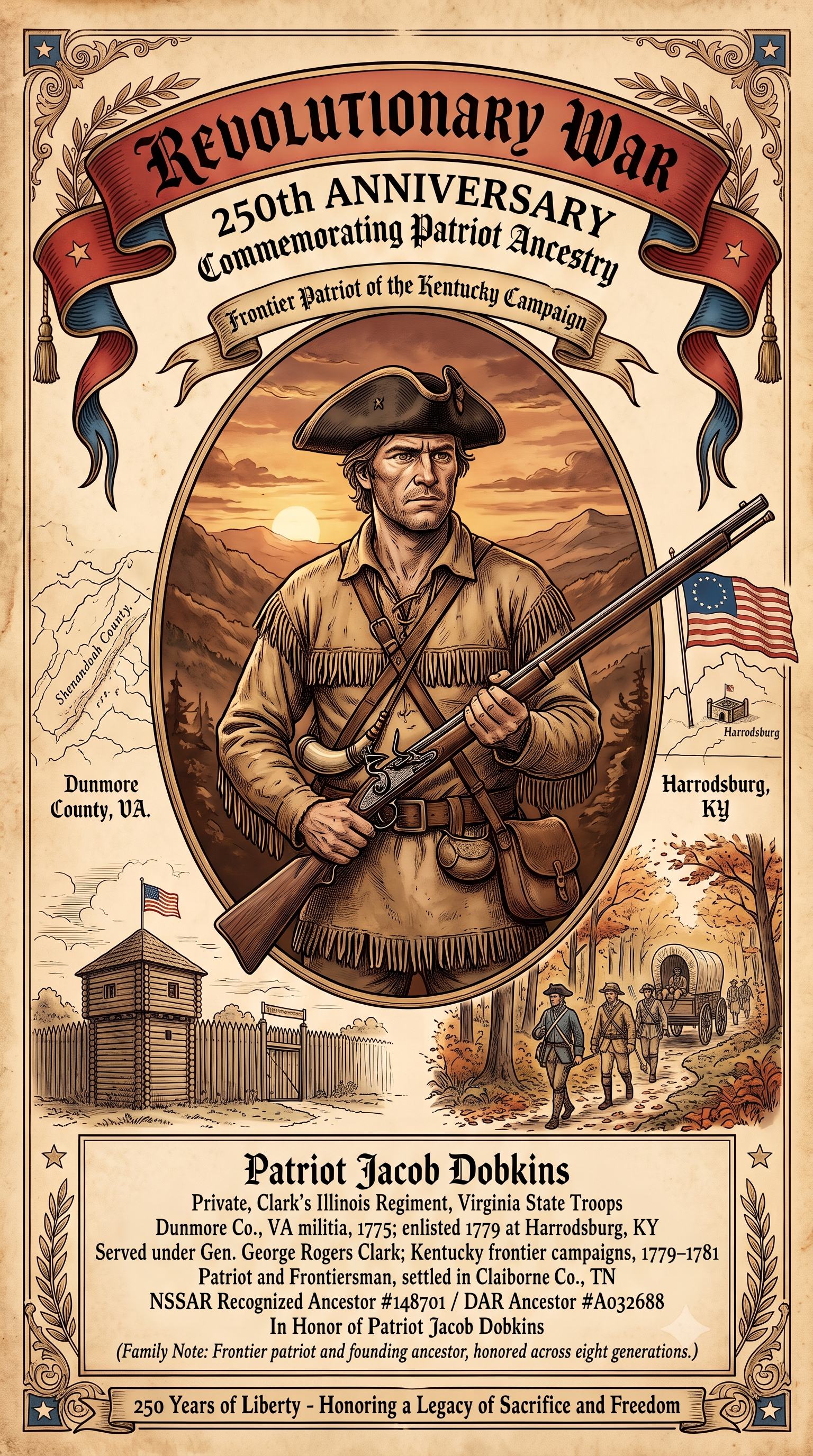
A Son of Virginia
Jacob Dobkins was born around 1751, most likely in Augusta County, Virginia. His father was Capt. John Dobkins. His mother, Elizabeth, is said to have been a Moore, but no record has been found that confirms it.
In the fall of 1775 Jacob married Dorcas “Darcus” Johnson in Dunmore County, Virginia, which was renamed Shenandoah County in 1778. The register doesn’t give a date, but the entry falls between couples married on 6 September and 2 October 1775. He was about twenty-four. The Revolution had already started that April at Lexington and Concord.
The Dunmore Militia
A militia roster dated 29 May 1775 lists Jacob in the Dunmore County company of Capt. Jacob Holeman. Evan and Reuben, who researchers believe were his brothers, are on the roster with him. It’s a separate record from the service he described under oath years later, and it’s from an earlier time and a different place.
Harrodsburg and the Kentucky Frontier
By his own sworn account, Jacob’s documented service began in May 1779. He was living at Harrodsburg, Kentucky, when he enlisted under Capt. Robert Todd. Todd’s company served under Col. Bowman, who soon marched against the Chillicothe towns. Todd’s men stayed behind to guard the fort at Harrodsburg, and Jacob was there through the winter.
In the spring of 1780 he was moved to Capt. Hugh McGary’s company. McGary’s men marched to Shawnee Springs and built a fort, then went on to the Falls of the Ohio to guard the army’s artillery as it came upriver. There they joined Gen. George Rogers Clark.
Bullet Holes Through His Clothes
In July 1780 Clark sent the army upriver to hunt for provisions. Jacob’s company marched to the mouth of the Kentucky River and tried to cross to the main army camped on the other side. Warriors attacked them at the crossing, and ten of his company were killed.
The army went on to the site of Cincinnati, joined Col. Logan’s troops and built a blockhouse. From there it pushed on to the Chillicothe towns and found them empty. In August 1780 it caught up with the Shawnee at the Pickaway towns, and the battle there lasted about three and a half hours. Jacob said his side lost about twenty-eight men, on top of the ten already lost at the river. He wasn’t wounded, but in his own words, “there was serveral bullet holes through his clothes.”
After the battle his company returned to Shawnee Springs and stayed until August 1781. There was no other general engagement in that time, only scouting parties. By his own count he served more than two years. He didn’t remember receiving a discharge, and if he ever had one, it was long gone.
What About Kings Mountain?
Some family trees put Jacob at the Battle of Kings Mountain in October 1780. His pension declaration doesn’t mention it, and it places him at Shawnee Springs from August 1780 to August 1781, hundreds of miles from the Carolina backcountry. One secondary source, Pat Alderson’s The Overmountain Men, lists him there, and no complete roster of the battle survives. Until a record from the time turns up, Kings Mountain stays an open question. The service Jacob swore to doesn’t depend on it.
To the Powell River
The records after the war are scattered, and the order of his moves is still being worked out. He’s on the Virginia tax lists in 1783 and in Shenandoah County around 1790. He signed a 1789 petition to the governor of North Carolina from Washington County, in the western lands that later became Tennessee. By 1792 he was in Jefferson County, where he sued John Sevier, later Tennessee’s first governor. He bought land there in 1795. By 1801 he was in Claiborne County on the Powell River, where he attended the county’s first court session. He spent the rest of his life there turning frontier into farmland.
After his death, his heirs quitclaimed the homestead to his daughter Elizabeth “Betsy,” the wife of George W. Campbell. Her descendants lived on the land until 1969. A log cabin there was later enclosed in a larger house. In 2021 an enormous old maple still stood over a small family burial ground at the back of the property, where most of the graves are marked with plain fieldstones. Jacob and Dorcas are believed to rest there.
The Will and the Suit for Freedom
Jacob held enslaved people, as many of his neighbors on that frontier did. What sets his story apart is what he put in his will before he died. In May 1831 he signed a will drawn up by Sheriff John Hunt and witnessed by William and Randal Lanham. The text preserved in the court record reads:
“I Jacob Dobkins do direct and will that all my slaves shall be set free at my death, and be emancipated according to Law. I do appoint Solomon Dobkins & John Hunt my executors.”
Jacob died in late 1835, and the will was never probated. According to researcher Roberta Estes’s reading of the case, his son Solomon pushed to have it destroyed so the enslaved people could be divided among the heirs. His daughter Elizabeth Campbell kept the will and later admitted under oath that she’d had it. The original disappeared, and the court worked from a reconstructed text.
In September 1850 six people sued for their freedom in the chancery court at Tazewell: Amy Louisa Deadrick; her children Cynthia Ann, Lewis, Nelson and Hessy; and her brother Isam Jefferson.
On 5 October 1850, days after the suit was filed, Solomon signed an agreement to “free My negrow Boy Jefferson” and give him a horse, saddle and bridle. The condition was that Jefferson drop his suit and give up any claim for his labor since “My Oald Master Jacob Dobkins Deceist.” It was a settlement offer, not the carrying out of Jacob’s will, and it didn’t end the case. Isam Jefferson was still a complainant when the court ruled.
In September 1851 Solomon’s side deposed his sister Jane. Solomon asked whether their father had divided his enslaved people among his children before he died. She said she knew nothing of her own knowledge. When the other side’s lawyer asked her age and whether she could read, she gave the answer quoted at the top of this page, and she signed with her mark.
In June 1853 the chancery court declared all six entitled to their freedom. It told them to apply to the county court for emancipation and ordered an accounting of what they were owed for their labor. Solomon had died in Texas by then. That September the Tennessee Supreme Court record was endorsed:
“Motion to dismiss disallowed. Affirmed, and remanded to the chancery court. Defts to pay the costs of this court.”
The records we’ve seen so far don’t show the date the six were actually emancipated. The Claiborne County court minutes should, and we’re looking.
Jacob’s instruction was for freedom. His family fought it for years, and it took a court to enforce it. That’s part of his story, and we tell it here.
A Soldier’s Last Years
On 15 September 1832, at about eighty-one, Jacob made his pension declaration in Claiborne County before Justice John Hurst. He said he was very infirm. About fifteen years earlier he’d broken his shoulder and collarbone, and the injury left him badly disabled. He suffered from rheumatism and hadn’t been to a court in fifteen years. He had no discharge, no papers and no living witness to his service. His sworn word was what he had, and the pension he was granted carries the number S3305.
He died in Claiborne County in late 1835, on the land he’d worked for more than thirty years.
From Jacob to Today
Jacob and Dorcas raised a large family. Their children included John, Elizabeth, Jane, Margaret, Solomon and Reuben. Jane married John Campbell, and their daughter Rutha married Preston Holt. From there, Jacob’s line runs down through the Holts of Pike County.
- Jacob Dobkins and Dorcas Johnson
- Jane Dobkins, who married John Campbell
- Rutha Campbell, who married Preston Holt
- Henry Holt
- Perian Holt
- Landon Holt
- Romaine Marie Holt
- Barrett Holt
Jacob is Barrett’s fifth-great-grandfather.